

Five Signs Your 8D Report Is Closed But Not Fixed
Most 8D reports look finished. Five checks, readable in the paperwork alone, show whether the defect actually stopped.
“Problem solved. Case closed. Signed. Filed.”
Nine months later the same defect returns.
Open the archive behind that report and most of what you find looks finished. Few of those reports actually are, and the five signs of a broken one are not on the shop floor. They sit in the paperwork, and a reader can find every one of them without leaving a desk.
Why this is not optional
8D is not a general preference for structured problem solving. Ford’s own IATF Customer-Specific Requirements set two clocks on a supplier quality reject: a response within 24 hours, with containment implemented in that same window, and the full 8D, with root cause and a corrective action plan, delivered within 15 calendar days.
Those two clocks measure different things. The 24-hour clock protects the customer today. The 15-day report is supposed to prove the cause was actually found and fixed, not just held back. A report that never separated D3 from D5 can meet both deadlines on the calendar and still fail the second one in substance.
The paperwork already tells you
An 8D report exists to prove two things: that the team understood what went wrong, and that they stopped it from happening again. Most reports only prove the first one, and only sometimes.
Five checks separate a report that closed from a report that worked. Read them in order, against your own last closed 8D.
One: containment wearing the coat of correction
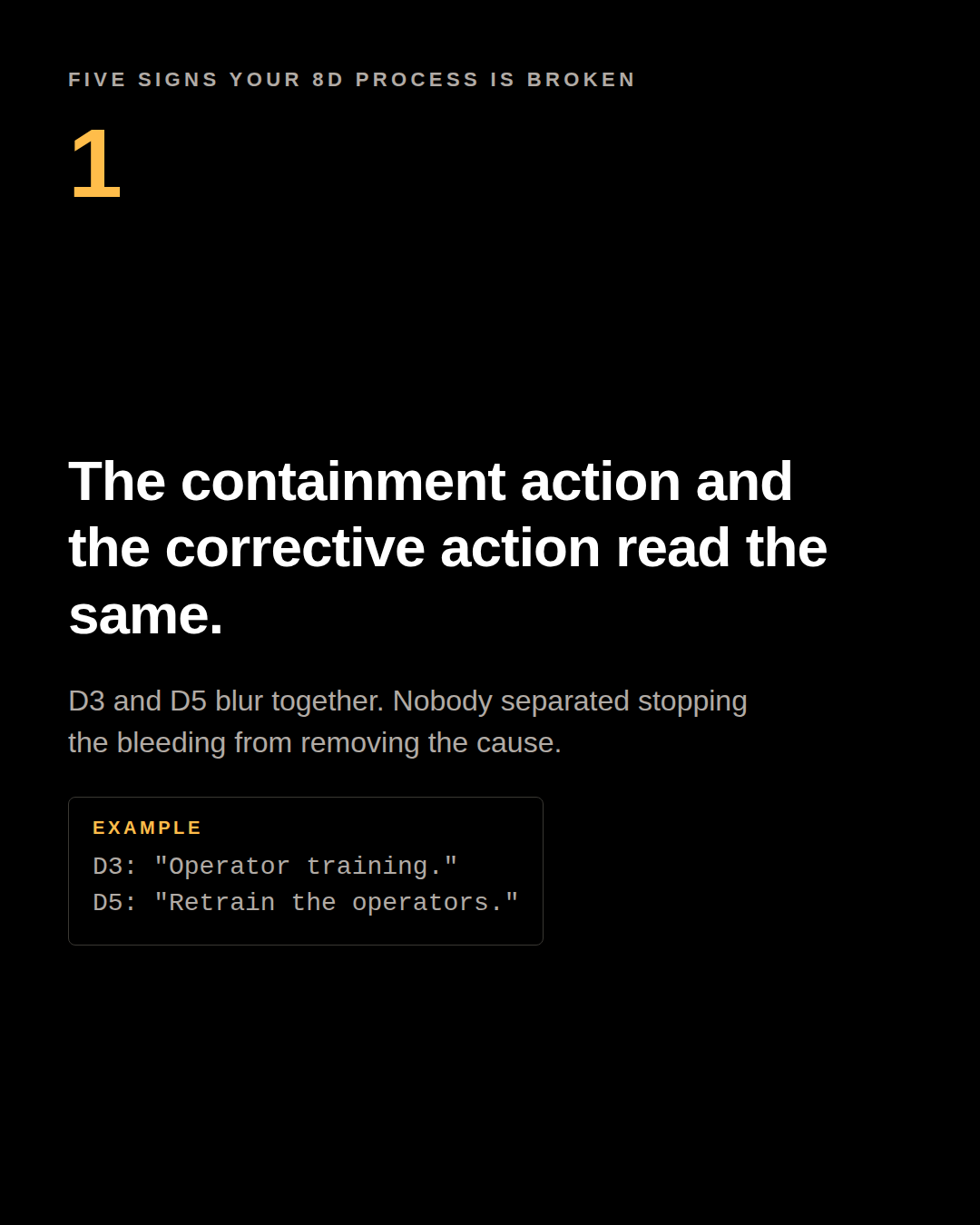
D3 is the interim containment plan: sort the parts, add an inspection, stop the bleeding. D5 verifies and selects the permanent correction, the fix that removes the cause. D6 then implements it.
When D3 and D5 read the same line, the stopgap never became a fix. “Operator training” in D3 and “retrain the operators” in D5 name one action twice, not two different ones.
The 8D framework, dating to Ford’s 1987 Team Oriented Problem Solving manual, keeps these as separate steps on purpose. A containment action buys time. A correction removes the cause that made containment necessary in the first place. A report that cannot tell the two apart never actually tested whether the cause was removed.
Two: a description that fits in three lines
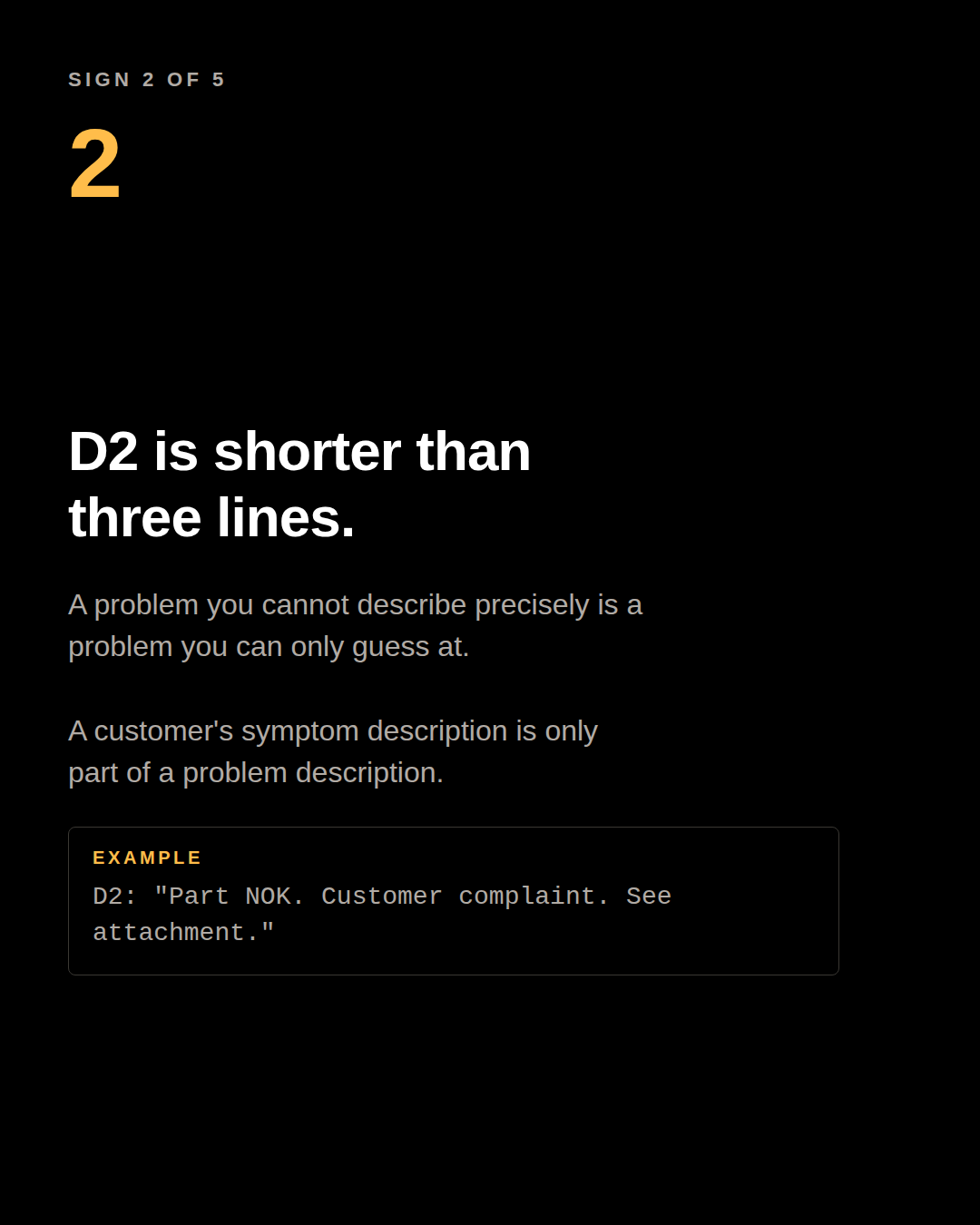
D2 exists to describe the problem in terms specific enough to search against: what, where, when, how much. A description shorter than three lines is usually a symptom restated, not a description.
This sign deserves its own case, not a paragraph. Two Years to Describe One Defect covers it in full: a defect that took two years to describe and weeks to fix once it could be reproduced on demand.
Three: the field marked “is not,” left blank
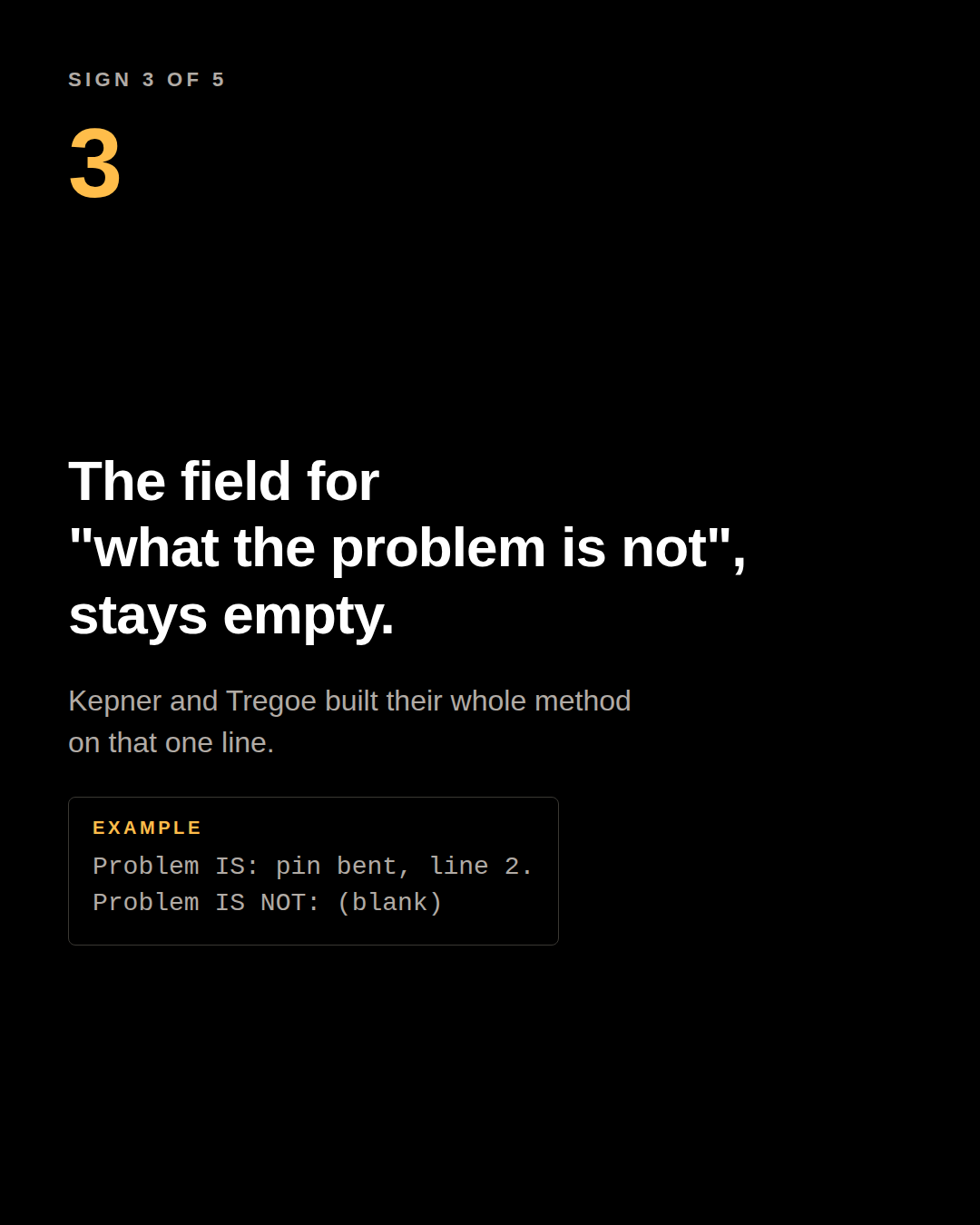
Charles Kepner and Benjamin Tregoe built a method around one question most reports skip: where does the defect never appear. Their 1965 book, The Rational Manager, structures every problem the same way: state where it IS, then state where it IS NOT. The distance between the two columns is the only place a root cause can live.
VDA, the German automotive industry association, recommends the Kepner-Tregoe IS/IS NOT method specifically for D2 and D4 of an 8D report, and treats it as a mark of an audit-ready analysis. A report with the IS field filled and the IS NOT field blank has narrowed nothing. Every theory is still possible.
Four: no verification date, anywhere
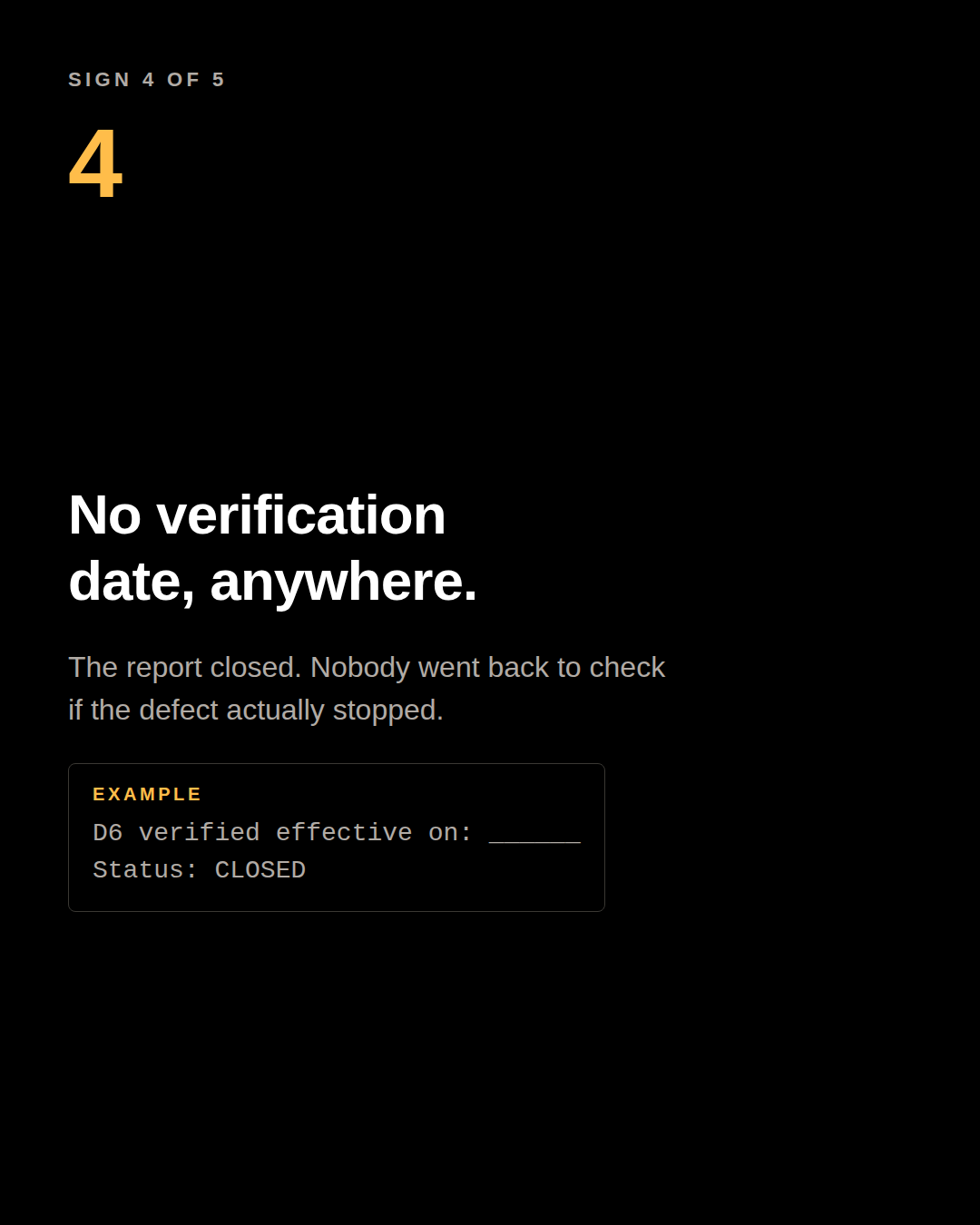
D6 exists to confirm, after a fixed interval, that the corrective action actually stopped the defect. A report can implement a fix and still never check whether it worked.
A closed report with no verification date recorded the intention to check. It did not record the check.
Five: one root cause, three report numbers
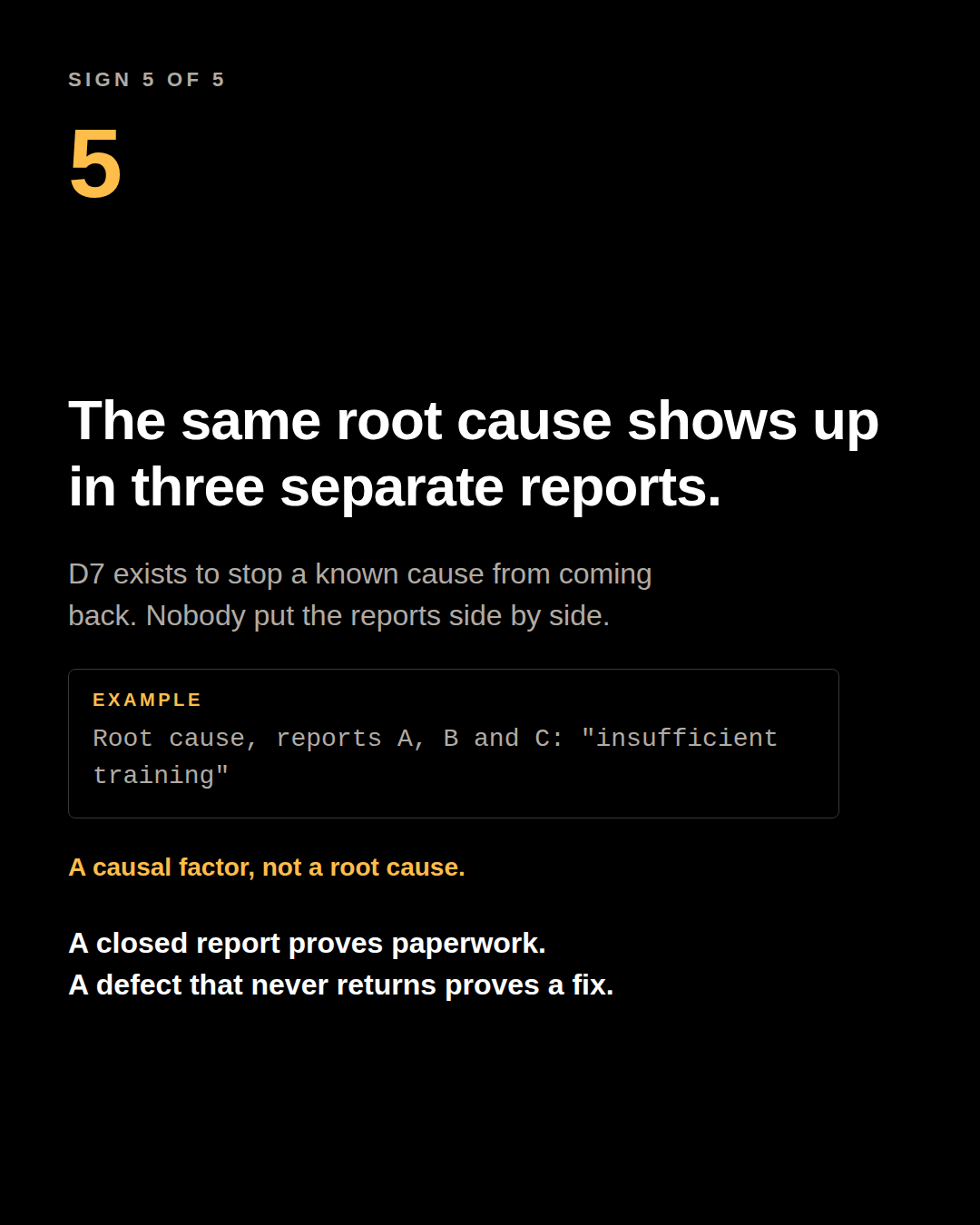
D7 exists to prevent a known cause from returning elsewhere in the plant. That only works if someone compares new reports against old ones.
When the same root cause appears in three separate report numbers, D7 failed before it started: nobody put the reports side by side. TapRooT, a root cause methodology used across heavy industry, draws a specific line here. “Insufficient training” is a causal factor, the point where a process let an error through, not a root cause, the reason the process allowed that gap to exist. A report that stops at the causal factor closes. The gap that let it through stays open for the next report.
Why reports pass and defects don’t
James Reason, at the University of Manchester, published the Swiss cheese model in 1990. Every layer of a safety system has holes. Most of the time the holes sit in different places on different layers, and nothing gets through. A failure happens when the holes line up.
An 8D archive works the same way. Each report catches its own hole. Nobody lines the reports up against each other. The form was built to be signed, not to catch a defect that returns through a gap five separate reports already described on their own.
A leak I worked once had been open for fifteen years. Once we wrote down what it actually was, the whole problem, every process step it touched, the fix took four days and it was solved for good. The paperwork had never been the hard part. Writing an accurate description of the problem was.
Not every problem earns an 8D
8D is built for customer complaints and for problems serious enough to justify a full team investigation. Running an internal deviation or a minor scrap event through all eight disciplines spends a week of engineering time on a problem that needed an afternoon.
4-Step covers internal deviations. PDCA covers continuous improvement. Just-Do-It covers anything trivial enough to fix on sight. The method should shorten the path to a fix. The wrong method only lengthens it.
What actually closes a report
A signed 8D proves the paperwork got filled in. A defect that never comes back proves the fix worked. Only one of those two claims deserves the word “closed.”
Pull your own last closed 8D. Check the five signs against it, in order. Most reports fail at least one.
More on galileon.si
- Two Years to Describe One Defect: What Toyota’s Recall Teaches About Problem Definition - the full case behind sign two, where the problem description was the entire two-year cost.
- How SolveR works
- Data handling
References
- AllAboutLean, “The History of the 8D Problem Solving Process”, accessed 1. 9. 2026 - origin of 8D in Ford’s 1987 Team Oriented Problem Solving (TOPS) manual.
- Ford, IATF Customer-Specific Requirements, section 10.2.2, accessed 1. 9. 2026 - 24-hour response and containment, 15 calendar days for the full 8D with root cause and a corrective/preventive action plan.
- Charles H. Kepner, Benjamin B. Tregoe, The Rational Manager, 1965 - origin of the IS / IS NOT problem specification.
- Kepner-Tregoe, “8D Problem Solving: VDA recommends Kepner-Tregoe IS and IS NOT”, accessed 1. 9. 2026.
- James Reason, “Human Error: Models and Management,” Philosophical Transactions of the Royal Society of London, Series B, vol. 327, 1990, pp. 475-484 - origin of the Swiss cheese model.
- TapRooT, “What Is a Causal Factor?”, accessed 1. 9. 2026.