

A3 templates forget what failed
An A3 report template on one page: background, current state, target with a date, root cause, countermeasures, check, follow-up and what did not work.
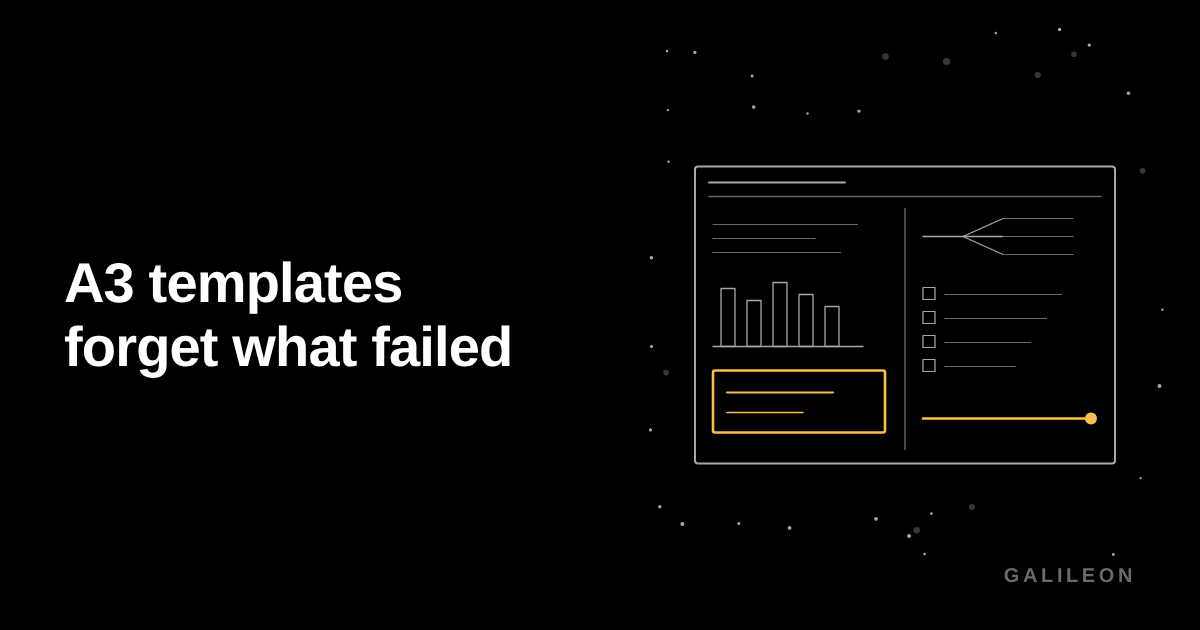
An A3 report template is one landscape A3 page that tells a problem in PDCA order: background, current state, target and root cause on the left, countermeasures, check and follow-up on the right. One owner writes it, usually with a mentor who asks the questions.
We compared five published A3 templates and guides, from Swiss, German and Swedish sources and the Kaizen Institute, in November 2026. All five ask for a check of the effect.
Only one asks for a date on the target. Only one asks what the team tried and dropped.
The A3 report template, field by field
| Field | Side | What to write |
|---|---|---|
| Title, owner, mentor | Top | The problem in one line, who owns it, who coaches |
| Background | Plan | Why this problem matters now, for whom |
| Current state | Plan | The data: where, when, how often, against which baseline |
| Target | Plan | A value and a date, measured the same way as the current state |
| Root cause | Plan | The verified cause, and the test that verified it |
| Countermeasures | Do | What, who, by when |
| Check | Check | Before and after, against the target |
| Follow-up | Act | The new standard, where else it applies, the next step |
| What did not work | Act | Causes ruled out and countermeasures dropped, and why |
Copy the table onto one landscape A3 page, Plan on the left and the rest on the right.
The page is 297 × 420 mm, the A3 size of ISO 216.
What five published templates leave out
| Template | Measurable target | Date on target | Check | Follow-up | What was dropped | Owner field |
|---|---|---|---|---|---|---|
| ZHAW, Switzerland, 2016 | yes | no | yes | yes | no | yes |
| YOKOTEN, Germany, 2016 | yes, where possible | no | yes | yes | no | yes |
| QZ, Germany, 2020 | no | no | yes | yes | no | yes (author) |
| Kaizen Institute, 2026 | yes | yes | yes | partly | no | no |
| Region Västmanland, Sweden, 2026 | yes | no | yes | yes | yes | yes |
Four of the five ask for a measurable target. Only the Kaizen Institute guide asks for a time frame with it.
Without a date, the check has nothing to compare against: a target with a value but no date can wait forever.
Only the Swedish template asks for lessons from activities that were carried out or discarded. The other four have no place for causes the team ruled out or countermeasures it dropped.
None of the five has a field for a mentor or coach. Yet ZHAW recommends a coach for the first A3s, and the YOKOTEN article calls writing an A3 alone a common mistake.
Who writes the A3, and how long it runs
One owner keeps the A3 until the target is met, often with a small team. The YOKOTEN article works in teams of three to five people.
A mentor or coach does not write the A3. A lean coach at LEI Hungary advises getting a mentor “to guide you with the right questions”.
The same article recommends PDCA cycles of two to six weeks, with a new A3 for the next cycle, and warns about A3s that stay open for more than a year.
A3 or 8D
An A3 explains a problem to the plant, and an 8D answers a customer.
The five European supplier requirements we read for this series are all written around the 8D report, and none of them mentions A3. When a customer expects an answer, the A3 is your internal page, not the report you send.
Start with one open problem
- Take one problem that is open today.
- Fill the page with a pencil, Plan side first.
- Give the target a value and a date before you write a single countermeasure.
- Ask your mentor to read it and write down every question.
If the mentor cannot tell what the plant will see on the target date, the Plan side is not finished.
In SolveR, the A3 is the result of the case on one page, and a closed A3 stays in the knowledge base with its confirmed cause, countermeasures and check, so the next team finds it.
More on galileon.si
- The A3 method, step by step
- Which method for which problem
- 8D or A3: which one your problem needs
- Unread lessons learned are just an archive
References
- ISO 216:2007, Writing paper and certain classes of printed matter, Trimmed sizes, A and B series. ISO
- Christophe Vetterli and Eva Hollenstein, A3, in LHT-BOK, ZHAW Winterthur Institute of Health Economics (Switzerland), 2016. ZHAW
- Christoph Roser (Hochschule Karlsruhe), Der A3-Report: Mehr als nur eine Problemlösungsmethode, YOKOTEN Magazin 03/2016, pp. 18-22 (Germany). PDF
- Michael Burghartz-Widmann, A3 statt 8D?, QZ Qualität und Zuverlässigkeit 65 (2020) 9, pp. 18-20, Carl Hanser Verlag (Germany). PDF
- Maria Mendonca, A3-Problemlösungsstrategien, Kaizen Institute, 18 May 2026. Kaizen Institute
- Region Västmanland (Sweden), A3-mall, ständiga förbättringar, 28 January 2026. PDF
- Csaba Barhács (LEI Hungary), A3 mistakes and misconceptions, part 1, Planet Lean, 13 December 2024. Planet Lean