
Europe's productivity is stuck in spreadsheets
Knowledge management in manufacturing decides how often a plant pays twice for one problem. Why Europe's slow productivity growth starts there.

Knowledge management in manufacturing decides how often a plant pays twice for the same problem. In the EU, where an hour of work produced only 7% more in ten years, making every solved problem findable is one of the few levers left.
We were stuck on a hard problem. Then we learned that one engineer had researched it a few years earlier. It was all there, on his laptop, which held more than 20 years of his work.
Nobody else knew. The answer was already in the building.
Why knowledge management in manufacturing comes first
In my view, knowledge lost like this is where Europe’s productivity is stuck. It sits in what the company already knows and cannot find.
Knowledge management sounds like a software category. On the shop floor it is simpler. It is the question of whether the next person who hits a problem can find what the last person learned.
Most plants cannot answer yes. The rest of this post is about why that matters more now than it did ten years ago.
Europe’s hour barely moved
Eurostat measures what one hour of work produces, after inflation. For the EU, that figure grew 7% between 2015 and 2025.
Ten years of investment in equipment and software, and the hour is 7% better.
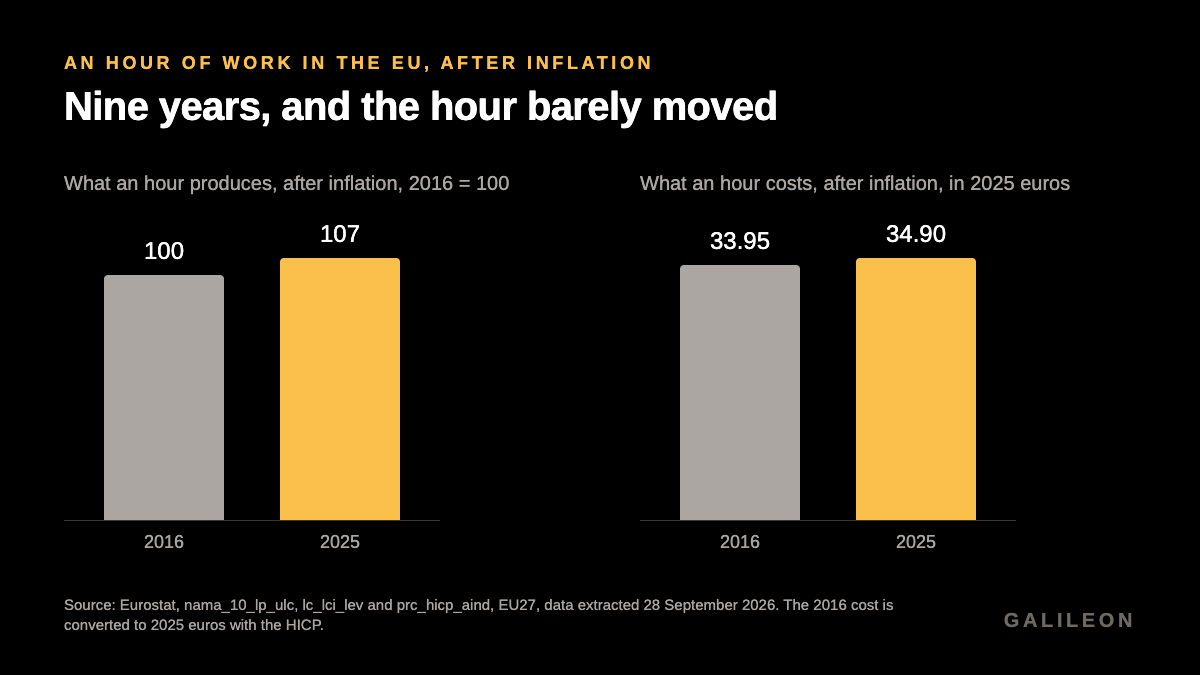
In the EU as a whole, cost is the smaller part of the story. An hour of work cost 25.6 euros in 2016 and 34.9 euros in 2025. In 2025 euros, the 2016 hour was worth 33.95 euros, so the real cost rose about 3%, less than output. Slovenia is a different case, further down.
The problem is how slowly output grows. Europe needs more out of every hour, and there are only a few ways to get it.
More people will not fix it
The obvious answer is to hire. The numbers close that door.
The Draghi report on European competitiveness, published in September 2024, puts it this way: “By 2040, the workforce is projected to shrink by close to 2 million workers each year.”
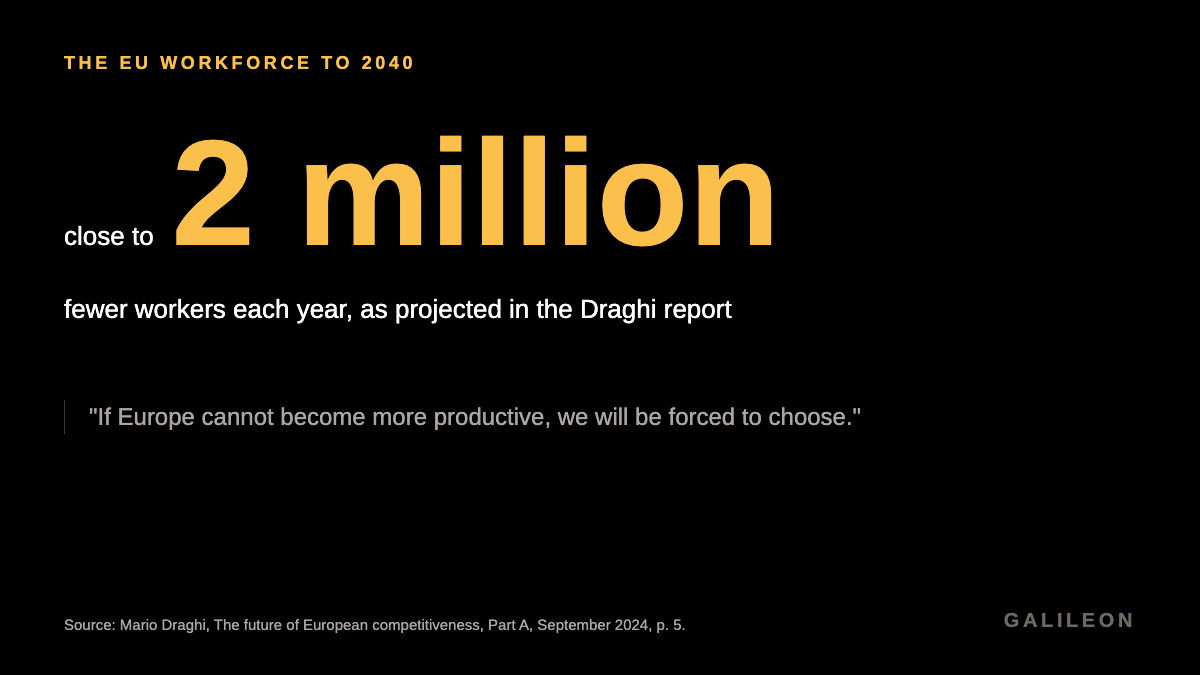
The same report gives the consequence in one line: “If Europe cannot become more productive, we will be forced to choose.”
Longer hours will not fix it either
The second obvious answer is to work more. Economic history has tested that.
John Pencavel of Stanford studied British munition factories during the First World War. Output rose with hours only up to a point. Past it, extra hours added almost nothing.
One comparison stands out. Workers on 48 hours over six days, with Sunday off, produced slightly more than workers on 70 hours over seven days.
A tired team works slower on a hard problem, and makes more new ones on the way.
The costliest problems are old ones
What is left is getting more out of every hour. In quality, one place stands out.
Customers keep telling me the same thing. The costliest problems are not new. They are forgotten.
They are rare for the people on shift. A defect that appears once every few years is new to the team that meets it. For the company it is old news. Someone solved it before.
The answer usually sits in one of four places:
- An old 8D report, filed by number and date.
- A spreadsheet with no header row, on a shared drive.
- A folder only one person understands.
- One person’s head, or their laptop.
None of these can be searched by the question the next engineer actually asks: “has anything like this happened before on this line?”
So the team starts again, and the line and the customer wait. Nobody records those hours as waste, because they look like work.
What the evidence says
A study published in the Quarterly Journal of Economics in 2025 tested what happens when that kind of answer is shared.
Erik Brynjolfsson, Danielle Li and Lindsey Raymond followed 5,172 customer support agents. The company gave them an AI assistant trained on how its best agents had solved past cases.
Three findings matter here:
- The largest gains came on moderately rare problems, where agents had little experience of their own but the system still had enough past cases to learn from.
- Less experienced agents gained the most. The most experienced gained little.
- Agents with two months on the job and the assistant performed as well as agents with more than six months and no assistant.
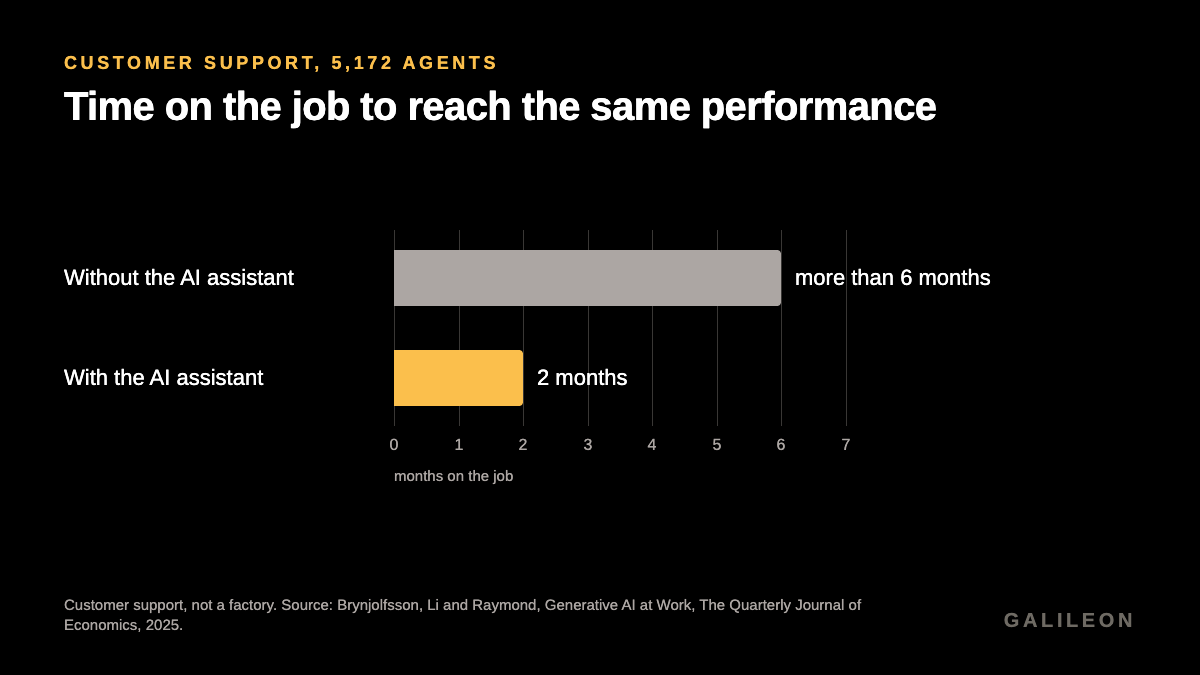
That was customer support, not a factory. I think a factory works the same way, because its costliest problems are rare too. That is my reading of the study, and the study does not test it.
The mechanism is what carries over. The assistant made what the best agents knew reachable for everyone else.
What changes on the shop floor
Connect every quality problem the company has solved, and let anyone search it. The best engineer’s knowledge reaches everyone.
Here is the same rare problem, before and after.
| Knowledge in reports, folders and heads | Knowledge anyone can search | |
|---|---|---|
| Where the last solution is | an 8D report, a spreadsheet, one laptop | one record, found by symptom, part or machine |
| Who knows it exists | the person who solved it, if still there | anyone who asks |
| First hour of a rare problem | meetings to rebuild what is already known | reading what was tried and what worked |
| New engineer | learns by repeating old work | starts from the last solution |
| Line and customer | wait for the whole solve | get an answer sooner |
| Cost of poor quality | paid again each time | paid once, then falls |
In my view, the line restarts sooner and the customer gets an answer sooner. Harder problems get solved, and the cost of poor quality falls.
Slovenia, a sharper case
In Slovenia the pressure is higher, because the cost of the hour is moving faster than its output.
Between 2016 and 2025, the real cost of an hour of work in Slovenia rose 35%. Output per hour rose 16%. Both figures are after inflation and come from Eurostat data.
A simple test shows the gap. If the 2016 hourly cost of 16.8 euros had grown only with productivity and prices, it would have been 25.6 euros in 2025. The actual figure was 29.7 euros. That is 4.1 euros an hour that output did not cover. The calculation is ours, from Eurostat data.
In 2025 alone, hourly labour costs in Slovenia rose 9.3%, against 4.1% in the EU (Eurostat).
Slovenia’s productivity stood at 86% of the EU average in 2025, in purchasing power standards. UMAR, Slovenia’s Institute of Macroeconomic Analysis and Development, writes that the gap is closing only slowly. The European Innovation Scoreboard 2026 lists Slovenia as a Moderate Innovator.
Peter Wostner of UMAR said in 2023 that Slovenia has to drop the story that it is content with average. At the same presentation, RTV SLO reported his view that the benefits of AI will go mainly to countries that are ambitious, innovative and adapt quickly.
A plant cannot change the national figures. It can stop paying for the same problem twice.
And the people
Jobs are the fair worry.
The International Labour Organization looked at how exposed each occupation is to generative AI. Its conclusion is that most jobs will change rather than disappear.
Stanford researchers looked at US payroll records from ADP, up to June 2026. Employment for workers aged 22 to 25 has fallen in the occupations most exposed to AI, where AI substitutes for their tasks. Where AI complements people, employment is flat or rising.
In my view, that is the choice. Take repetitive and data work off people, and move them to work that adds more value. A searchable record of solved problems is that kind of use. It keeps the engineer and takes away the work of redoing what the company has already paid for.
One question for your plant
Take last year’s 10 most expensive quality problems.
How many had your company already solved once before?
FAQ
What is knowledge management in manufacturing?
It is the way a plant keeps what its people have learned, so that someone else can find it and use it. In quality, that means every solved problem stays searchable by symptom, part or machine, with its cause, its evidence and the action that worked. A report filed by number and date does not meet that test.
Why is Europe’s productivity growth so slow?
There are many reasons, and economists disagree on their weight. The numbers are clear: real output per hour worked in the EU grew about 7% between 2015 and 2025 (Eurostat). The Draghi report adds that the workforce will shrink by close to 2 million workers a year to 2040, so growth has to come from the hour itself.
Does AI in manufacturing replace jobs?
The International Labour Organization expects most jobs exposed to generative AI to change rather than disappear. Stanford researchers found that employment falls for young workers where AI substitutes for their tasks, and holds or rises where it complements people. The outcome depends on how a company uses it.
Why do quality problems repeat?
Because the costliest problems are rare for the people on shift and old news for the company. The first solution sits in an old report, a folder or one person’s head, and the next team cannot find it, so it starts again.
More on galileon.si
References
- Eurostat, Labour productivity and unit labour costs (nama_10_lp_ulc), real labour productivity per hour worked, index 2015 = 100, EU27 and Slovenia. Data extracted 28 September 2026. Eurostat data browser
- Eurostat, Labour cost levels by NACE Rev. 2 activity (lc_lci_lev), industry, construction and services, EU27 and Slovenia. Data extracted 28 September 2026. Eurostat data browser
- Eurostat, HICP annual average index (prc_hicp_aind), 2015 = 100, EU27 and Slovenia. Data extracted 28 September 2026. Eurostat data browser
- Eurostat, EU hourly labour costs ranged from €12 to €57 in 2025, news release, 31 March 2026. Eurostat news
- Mario Draghi, The future of European competitiveness, Part A, September 2024, p. 5. European Commission
- John Pencavel, The Productivity of Working Hours, The Economic Journal 125 (589), December 2015. Wiley, open version IZA DP 8129, April 2014
- Erik Brynjolfsson, Danielle Li, Lindsey Raymond, Generative AI at Work, The Quarterly Journal of Economics 140 (2), April 2025. Oxford Academic
- ILO and NASK, Generative AI and Jobs: A Refined Global Index of Occupational Exposure, 20 May 2025. ILO
- Erik Brynjolfsson, Bharat Chandar, Ruyu Chen, Canaries in the Coal Mine? Six Facts about the Recent Employment Effects of Artificial Intelligence, Stanford Digital Economy Lab, version of 12 August 2026. Stanford Digital Economy Lab
- UMAR, Poročilo o razvoju 2026 (Development Report 2026), May 2026, p. 19. UMAR
- European Commission, European Innovation Scoreboard 2026, 9 July 2026, and country profile Slovenia. European Commission, profile Slovenia
- RTV SLO, UMAR: za hitrejšo rast produktivnosti je potrebno več ambicioznosti in poguma, 6 December 2023. RTV SLO