

A root cause needs an off switch
Root cause analysis in manufacturing, step by step: from the problem description to a cause you can switch on and off, with Is/Is-not and 5 Why.
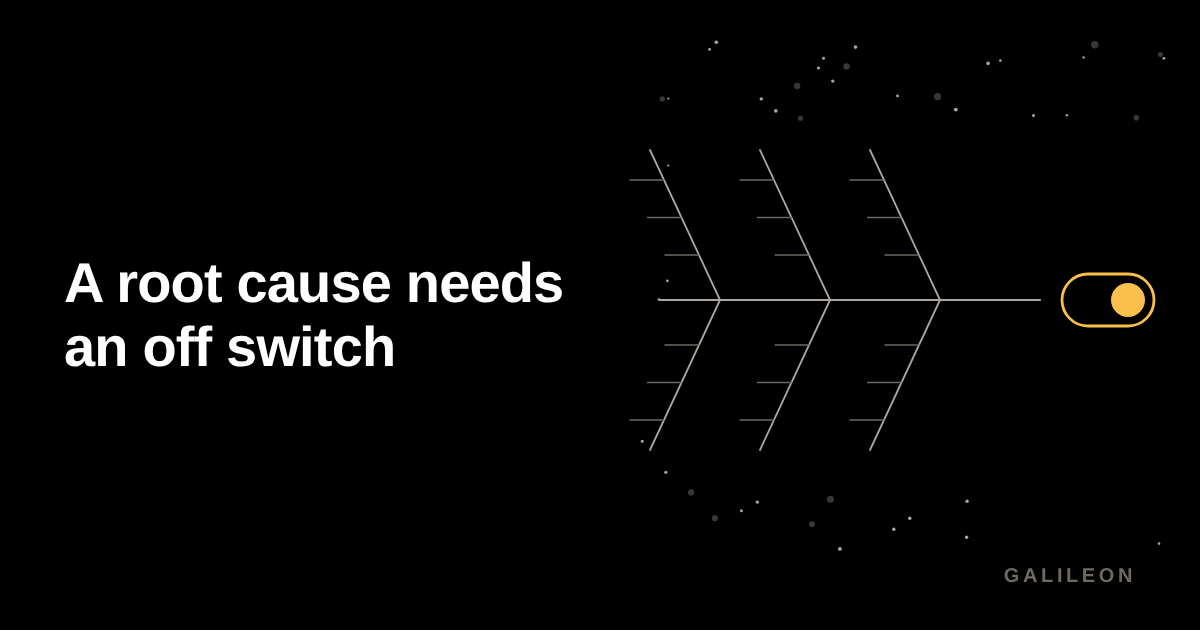
Root cause analysis in manufacturing is the work of finding why a defect happened and proving it, so the corrective action removes the cause. A cause is proven when changing it switches the defect on and off.
The TÜV Rheinland Akademie names a common mistake in 8D work: identifying only the “obvious” cause. An obvious cause fits the story. It has not been tested yet.
In my view, a cause that has not been switched on and off is a hypothesis, however well it fits.
Root cause analysis in five steps
1. Describe the problem before looking for causes
Write what is wrong, where, when and how much. Then write the same for where the defect does not occur: the other line, the other shift, the other batch.
That second column is the Is-not. It is the filter for step 3.
In a 2022 article in the German quality magazine QZ, a quality manager at an automotive supplier and a Kepner-Tregoe director name a misunderstood Is-not comparison as the most common error in 8D audits.
2. List possible causes, for occurrence and for escape
Every defect has two questions. Why was it made? Why was it not caught before it left the plant?
DeLaval asks its suppliers to ask “why” for both, and to relate the corrective actions to the occurrence root cause and the non-detection root cause. An Ishikawa diagram, with categories such as machine, method and material, helps the team list candidates for each.
In our pilot, an analysis counted only when it named at least one technical cause for why the defect occurred, one for why it was not detected, and an organisational cause for each of the two: four causes in total.
3. Rule causes out with the Is-not
Every candidate has to explain both columns. A cause that would also hit the line where the defect does not occur does not explain the problem, or not all of it.
This step makes a long list short. In our pilot, SolveR proposed 8 to 16 possible causes per case. Engineers kept 20 to 30 percent of them, and in every test so far the real root cause was among the ones they kept.
4. Ask why until the cause can be changed
From each remaining candidate, ask why until you reach a cause the team can change and test. Five is a rule of thumb. DeLaval writes “generally five times”.
Stop at a cause you can act on. When the answer is “operator error”, ask one more why: what made the error possible?
5. Switch it on and off
Change the cause and watch the defect. Put the old condition back, and the defect should return. Remove it, and the defect should stop.
Husqvarna’s 8D guide for suppliers asks for the same test in D6, for the corrective action: putting it in and taking it out “should work as a flip switch for turning on and off the problem”.
Some defects cannot be switched on safely or cheaply. Then the proof comes from facts: historical data and statistics, simulations and tests, and documented observations in the process. Husqvarna lists the same three.
What the record should show
Each cause, the test that proved it, and the result. Both the occurrence cause and the escape point. The causes that were ruled out, and why.
IEC 62740, the international standard on root cause analysis, excludes assigning responsibility or liability from its scope.
ISO 9001:2015, clause 10.2.1 b), asks a company to determine the causes of a nonconformity. The switch test is one way to show that it did.
SolveR proposes possible causes with their sources. Which cause is real, and which test proves it, stays the engineers’ decision.
More on galileon.si
- Two Years to Describe One Defect
- The 8D method, step by step
- Pilot results: 10 real 8D cases at 8 manufacturers
References
- IEC 62740:2015, Root cause analysis (RCA), adopted in Europe as EN 62740:2015. DIN
- ISO 9001:2015, Quality management systems, Requirements, clause 10.2.1. ISO
- TÜV Rheinland Akademie (Germany), Strukturierte Fehlerbehebung für höchste Qualität: der 8D-Report in der Praxis, 15 May 2025. TÜV Rheinland
- Steffen Dörrler (Allgaier Automotive) and Jens Refflinghaus (Kepner-Tregoe), 8D Reloaded, QZ Qualität und Zuverlässigkeit, 04/2022. PDF
- DeLaval (Sweden), 8D Process: A structured problem-solving methodology, information for suppliers, 7 July 2026. DeLaval
- Husqvarna Group (Sweden), 8D Pocket Guide, Issue D, no date. Husqvarna
- Matej Kalčič, Z umetno inteligenco podprt organizacijski spomin (AI-Powered Organizational Memory), proceedings of the 10th International Scientific Conference, Faculty of Industrial Engineering Novo mesto, 14 May 2026, pp. 77-82. PDF