

Engineers cross out most AI suggestions
Solving production problems with AI: AI searches and drafts, the engineer proves the cause. In our pilot, engineers kept 20 to 30 percent of AI causes.
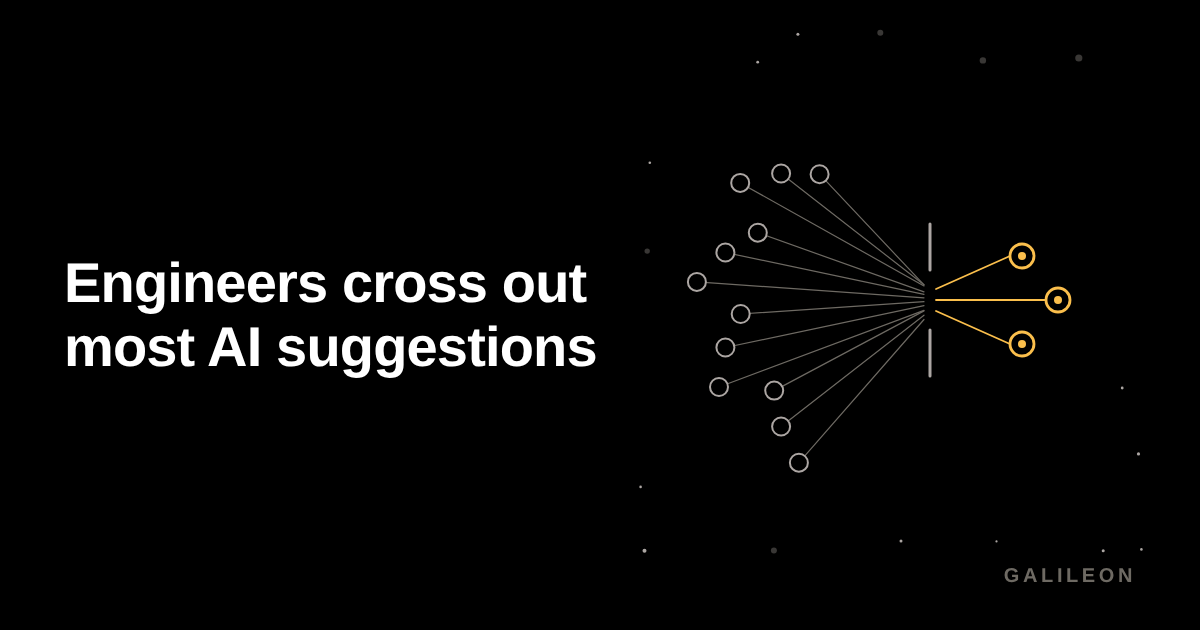
Solving production problems with AI means that AI does the searching and the paperwork, and the engineer proves the cause. AI drafts the problem description, finds similar closed cases and proposes possible causes; the team tests them and decides what goes into the report.
In our pilot, AI proposed 8 to 16 possible causes per case, and engineers kept 20 to 30 percent of them. In every test so far, the real root cause was among the ones they kept.
That split is what this post is about.
Solving production problems with AI, phase by phase
| Phase | What AI does | What the engineer decides |
|---|---|---|
| Clarification | Drafts the problem description from the complaint, the photos and the reports | Whether the description matches the part on the bench |
| Cause | Finds similar closed cases and proposes possible causes | Which causes to test, and which test proves them |
| Solution | Proposes actions that worked on similar cases | Which action fits this line, and how to check it |
| Transfer | Links the case to the closed cases it resembles | What changes in the standard |
The four phases are the ones Bosch uses to present every problem solving method, from 8D to DMAIC. More in Every method runs the same four phases.
Most suggestions get crossed out
A list of 8 to 16 causes is long. Most of it has to go, and only evidence can decide which part.
Bosch is strict here. In its problem solving booklet, the logic chain “must be based on facts”, and assumptions, suspicions or unclear formulations are not allowed.
The root cause is then confirmed by conclusive “reverse evidence”, from the available facts or from targeted tests such as DoE.
So a cause that AI suggests is a suspicion. It passes the same test as any other suspicion, or it is crossed out.
The engineer keeps the decision
The EU’s ethics guidelines for trustworthy AI put human agency and oversight first among seven requirements. AI systems should allow people “to make informed decisions”.
In quality work, that decision has names on it. The 8D report goes to the customer from the team, not from the software.
In my view, the crossed-out causes matter as much as the kept ones. A cause the team ruled out with a test is evidence too, and the next team should see it next to the one that was confirmed.
Three rules for AI in your next problem
- Treat every AI suggestion as a suspicion, and write down the test that would confirm it or rule it out.
- Keep closed cases in one place, with the confirmed cause, the ruled-out causes and the action that worked.
- Record who decided, and on which evidence, so a customer or an auditor can follow the case end to end.
In SolveR, suggested causes come from the plant’s own closed cases, and the engineer decides which of them go into D4.
More on galileon.si
- Every method runs the same four phases
- Pilot results: 10 real 8D cases at 8 manufacturers
- How SolveR works
- The 8D method, step by step
References
- Matej Kalčič, Z umetno inteligenco podprt organizacijski spomin (AI-Powered Organizational Memory), proceedings of the 10th International Scientific Conference, Faculty of Industrial Engineering Novo mesto, 14 May 2026, pp. 77-82. PDF
- Robert Bosch GmbH (Germany), Quality Management in the Bosch Group, Booklet No. 16, Problem Solving, 05.2013, sections 4.4 and 5.3.2. PDF
- High-Level Expert Group on Artificial Intelligence, European Commission, Ethics Guidelines for Trustworthy AI, 8 April 2019. European Commission